
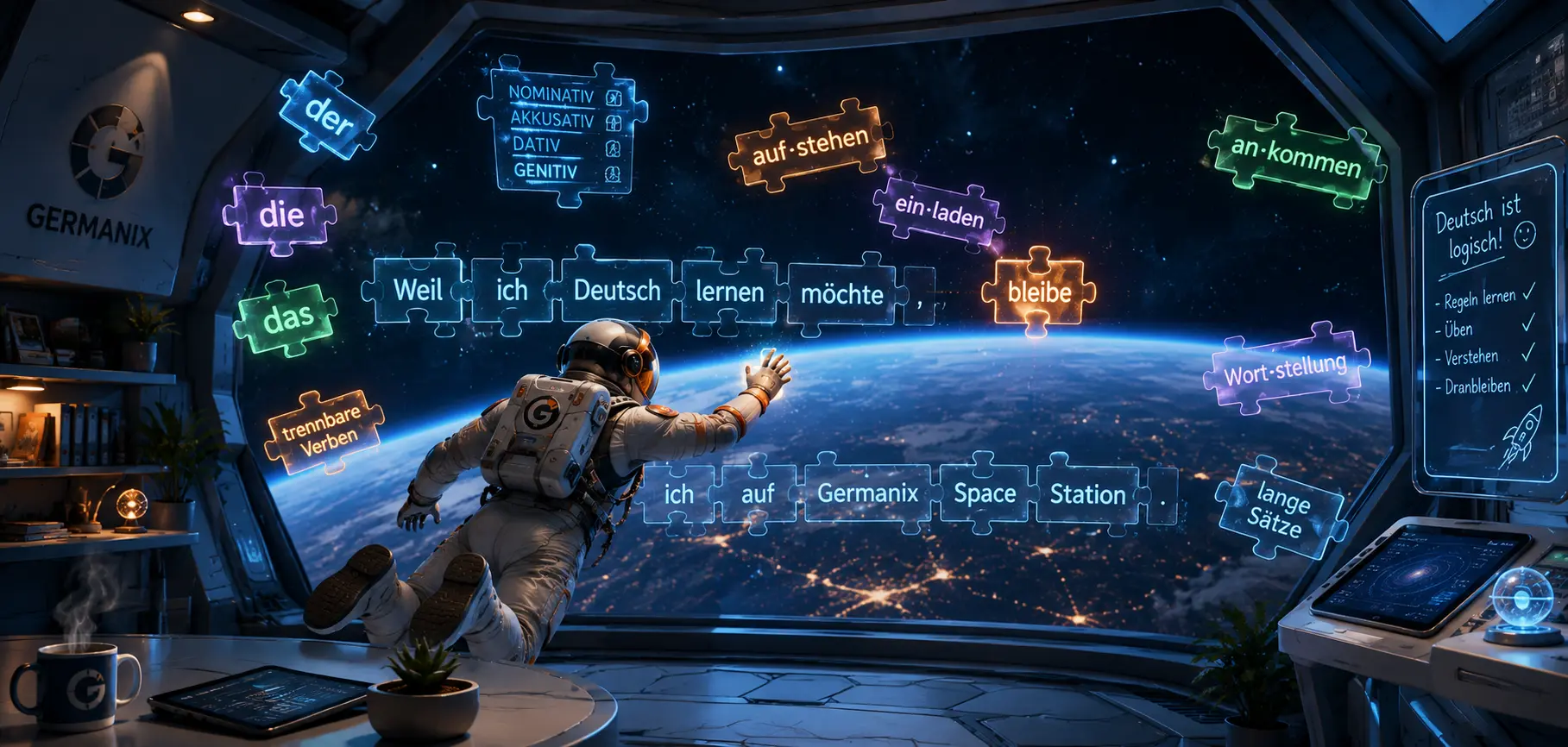
When languages are ranked by difficulty, German is usually considered one of the easier languages for English speakers to learn. This is mainly because large parts of English and German vocabulary originate from the same Germanic roots. Furthermore, the general language logic and sentence structure are very similar, with only a few additional twists and grammatical rules in German. As a result, English speakers often recognise many German words immediately and can usually follow and build longer sentences quite quickly.
How difficult is German really?
One of the first things people wonder before learning any language is how difficult it is going to be. Of course, you want to know what you are getting yourself into before starting something new. Asking how difficult a language is is actually a bit like asking how painful a tattoo is. The answer will always be: it depends.
In fact, it depends on many factors. That applies to both the tattoo and the language. Most of these factors are rooted in yourself. When you learn a new language, certain starting conditions will make it either easier or more difficult for you.
- What’s your native language?
- Do you know any other languages?
- Do you already know any Germanic language?
- Have you studied MANY languages before?
- Do you have a good ear for languages and pronunciation nuances?
- Are you able to imitate sounds well?
- Is it easy for you to remember grammar rules?
- How much time do you have to dedicate to studying your language of choice?
- Are you in a country or area where your study language is spoken?
The US Foreign Service Institute often serves as a reference point for language difficulty. According to its estimates, German takes around 750 classroom hours, or about 30 weeks of intensive study, for English speakers to reach a professional working level.
That places German above languages such as Spanish, French or Dutch in terms of difficulty, but far below languages such as Arabic, Mandarin, Japanese or Korean. Still, these numbers only tell one part of the story.
No language is difficult
This might sound like a bold claim, but in reality no language is per se more difficult than any other. Otherwise, we would have to assume that Arabic or Mandarin speakers must have a higher IQ or study a lot harder in infancy to “learn” their native language. That is obviously not the case. Children around the world struggle, or rather don’t struggle, in the same way to imitate the language that their parents and everyone around them speaks.
Infants do not study their native language, they absorb it. Babies come into this world with a huge problem to solve. They need to express their needs and understand the world around them. Crying, screaming and later pointing and babbling work well at first, but as their cognitive functions develop, their needs become more complex.
Before a child says their first words, they begin to grasp the meaning behind certain sounds their parents or other human beings make. First, they connect sound and meaning. Then, in a second phase, they try to imitate that sound.
Ideally, when learning a foreign language as adults, we should do exactly the same. There is only one scenario where this kind of works, and that is spending time in the country where the target language is spoken while being surrounded 24/7 by people who only communicate in that language. A bit like on the Germanix Space Station 😉
If we do not have the opportunity for full real life immersion, then we can return to the question of how difficult a language is to learn as an adult. Let’s take a look at what might be particularly difficult, or perhaps surprisingly easy, about the German language.
German Grammar can be challenging
If English is your first and only language, German grammar can be quite challenging. One of the hardest parts certainly are the cases, of which German has “only” four. Many languages have cases, but modern English does not, at least not directly. The concept of subject, direct object and indirect object does exist in the logic of English, but is not really represented through grammatical forms.
Whether you say “The pens are on the newspaper” or “the newspaper is under the pens”, neither the articles nor the nouns change, even though the subject and object roles swap .In German this becomes: “Die Stifte sind auf der Zeitung” vs. “Die Zeitung ist unter den Stiften”.
Which brings us to the next big struggle: the articles. Der, die, das. Every single noun has one of three possible grammatical genders: masculine, feminine or neuter. There is no real life logic behind which noun has which gender. Fridges are masculine, showers are feminine and roofs are neuter. Boys are masculine, of course, and girls are, of course… neuter. Yes.
Verbs also come with their own little cruelties. Separable verbs can be a nightmare for learners. The prefix is separated from the stem and moves all the way to the end of the sentence, no matter how long that sentence is.
Let’s say “I invite my friends for dinner at my house tomorrow night”. To invite in German is “einladen”. Because this is a separable verb, the sentence becomes: “Ich lade meine Freunde morgen Abend bei mir zu Hause zum Abendessen ein.” As you can see, the prefix of the verb concludes the sentence.
What if, after all those words, you forget the prefix? Well, then you are literally no longer inviting your friends, but instead “loading” or “charging” them.
German pronunciation? Piece of cake
One thing, on the other hand, that is surprisingly easy about German is the pronunciation. Standard German is quite neutral and easy to imitate for foreigners who can manage to mentally detach the pronunciation of letters from their own language.
What I mean is that just because the r is rolled in your language and German also has the letter r, you should not automatically keep rolling it in German. The same goes for every letter. Most sounds are very easy to imitate. The few exceptions, depending on your native language, are ch, ö and ü. Also, surprisingly many foreigners really struggle with the “long e”.
The best thing is that German words are almost always pronounced the way they are spelled. You only need to learn one fixed pronunciation per letter or letter combination and you are good to go for almost every word and sentence. The only real exception is ch, for which you need to learn exactly two different pronunciations.
You know how to pronounce “Auto”? Then you also know how to pronounce the “au” in any other word where it appears. Unless it is a French loan word, of course, but then it is technically not really a German word.
German is easier than its reputation
So, is German difficult? Yes and no. Some parts of the language can feel strange at first, especially grammar and word order. But German is also surprisingly logical, consistent and much easier to pronounce than many people expect. With enough exposure, patience and the right learning environment, it becomes far less intimidating than its reputation suggests.
