
Depending on your native language, some sounds in the German language can be really challenging. This applies to both vowels and consonants. One of the most challenging consonant combinations is “ch”. These two letters are an inseparable couple in German and appear absolutely everywhere. you can’t escape them, so you’d better make sure you know how to pronounce them correctly.
Guttural vs soft “ch”
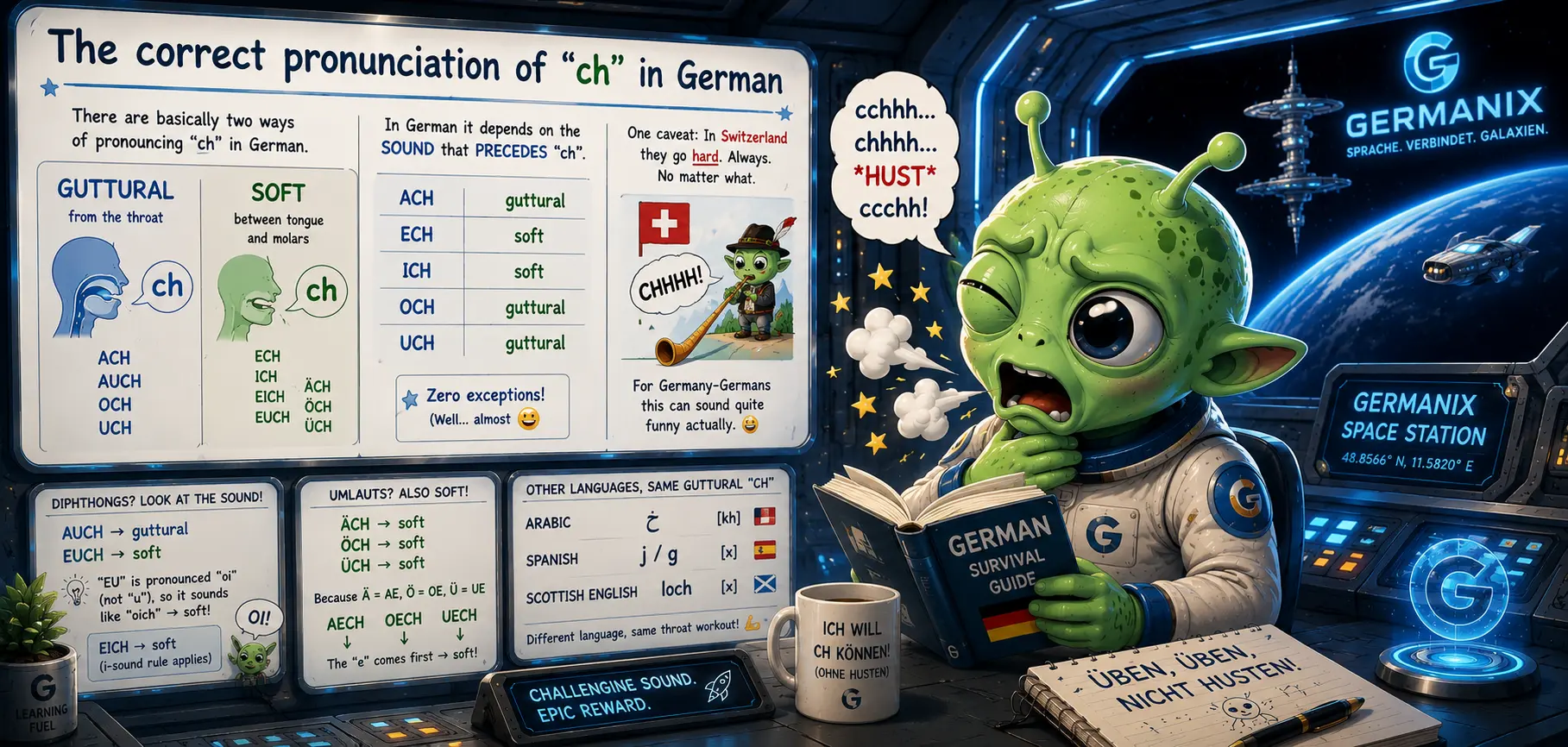
There are basically two ways of pronouncing “ch” in German. One is a guttural sound that comes from your throat. The other is a very soft sound that is produced between your tongue and your molars.
The guttural “ch” is very common in other languages around the world. In Arabic, for example, it is represented by the letter “خ”. In Spanish, it is often written as “j” or “g”, depending on the word. You can also hear a similar sound in Scottish English, for example in the word “loch”.
The soft “ch” on the other hand is absolutely unique in the German language. And it really is incredibly soft. Sometimes you’ll hardly hear it within a word. In order to reproduce it you have to teach your tongue a new kind of position within your mouth.
Basically all you have to do is to bite your tongue only with your molar teeth. The tip of your tongue stays well behind your front teeth at the bottom of your mouth. And now you beath out strongly. There it is, the soft german “ch”.
It all depends on the vowel BEFORE the ch
German is not the only language where the pronunciation of “ch” can vary. Especially in Romance languages, there are differences depending on the vowel that follows the “ch”. In German, on the other hand, it totally and only depends on the vowel, or sometimes the consonant, that PRECEDES the “ch”.
ACH → guttural
ECH → soft
ICH → soft
OCH → guttural
UCH → guttural
There are zero exceptions to this. One caveat, though: forget about this rule once you enter Switzerland. Swiss Germans like it hard. They tend to pronounce their “ch” in a guttural way consistently, no matter which vowel comes before it. For Germany-Germans, this can sound quite funny actually.
The “ch” after vowel combinations (diphthongs)
There is something hugely important still to understand about the ACH, ECH, ICH, OCH, UCH rule. It is not only the written letter that dictates the pronunciation of the “ch” that follows. It’s the sound the preceding letter or letters make.
When we look at so-called diphthongs, that is vowel combinations, this becomes very clear.
AUCH → guttural
EUCH → soft
Now you might wonder why the second combination creates a soft “ch” despite the letter “u” appearing before it. It’s because there is no actual “u” sound in this combination. “EU” is always pronounced “oi”, so what you end up with is a sound that leads to the soft “ch”. And yes, Europe in German is pronounced “Oiropa”, although it is spelled “Europa” of course.
Therefore, what you’re dealing with pronunciation-wise is “oich”, which however does not exist as a written diphthong in German.
Another very common diphthong is “EI”. The i-sound rule applies here too, so a combination like “EICH” results in a soft “ch”.
The “ch” after Ä, Ö and Ü (Umlaute)
And lastly, we need to look at the “ch” pronunciation after the famous German Umlauts. Umlauts are the vowels Ä, Ö and Ü. The “ch” works like this:
ÄCH → soft
ÖCH → soft
ÜCH → soft
This is because Ä, Ö and Ü are not simply variants of A, O and U. They are real additional vowels with entirely different pronunciations.
And the reason why “ch” is soft after those three is really, really simple. An alternative and actually correct way of spelling Ä, Ö and Ü is AE, OE and UE. So what we really have is:
AECH
OECH
UECH
The “e” is therefore the real preceding letter in this combination and dictates that the pronunciation of the “ch” construction is soft.
